Friends and students would think: "Are you crazy? It's free marketing PLUS money. Why refuse?"
Because saying NO is the most important career skill nobody teaches you.

The Yes Trap

I was very clear about what I wanted to do. Very focused. But even then, I'd say yes to things I shouldn't. More guest lectures than I could handle. Corporate trainings that paid well. Consulting projects that seemed interesting.
There's limited bandwidth. You need to prioritize. Because you have to think long-term.
Right now, I do fewer trainings. More guest lectures with students, because I enjoy that more. Corporate training is occasionally to stay industry-relevant. But I'm also working on tech, building features for our app.
Optimizing time means saying yes to limited things.
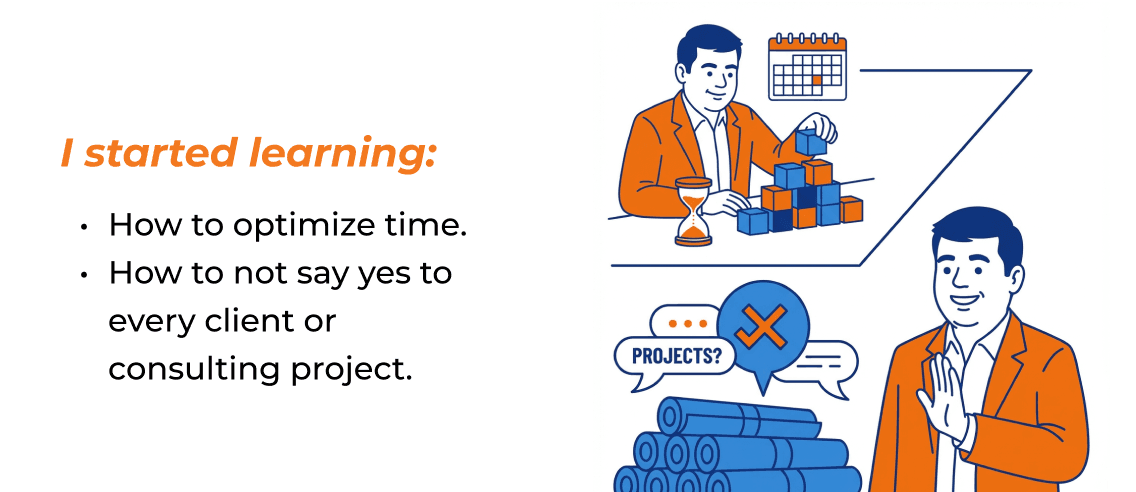
When I say yes to too many things, my me time suffers. And my students are my first priority. Always. I could never say no to them. So I had to start saying no to other engagements.
I take guest lectures at colleges but not full courses. I was offered a 15-hour course at a premier IIM. Good money. Prestigious. I said no. Because I can't do it repeatedly. It doesn't fit my long-term structure.
When I say yes to too many social engagements, I'm saying no to ME time. I need alone time to rejuvenate. When I over-commit socially, I lose that.
What Every YES Actually Means
You have 168 hours a week. Sleep takes 56. Spend 40 on teaching, that's 72. Subtract eating, family, life, maybe 30-40 productive hours remain.
Every yes eats into that limited resource.
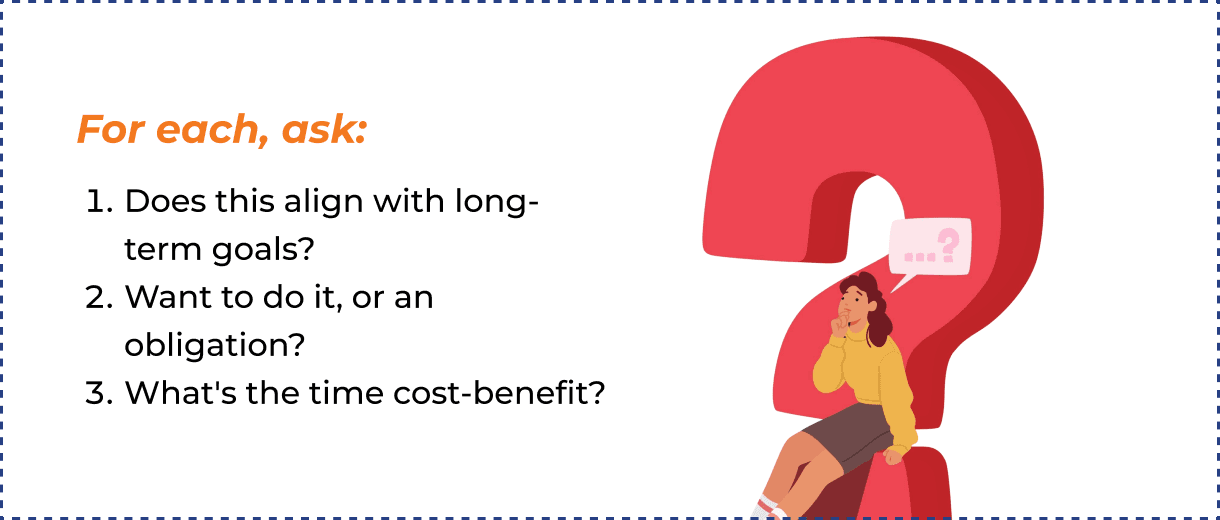
The Three Questions I Ask

1. Does this align with my long-term goals?
Not "Will I enjoy this today?" But: Does this add value long-term? I do 1-2 hour guest lectures and maximum 5-hour workshops. Those I can sustain. Recurring 15-hour commitments? No.
2. Am I doing this because I want to, or out of obligation?
If I want to attend a social event, I go. If it's just an obligation, I avoid it. I like one-on-one conversations. Or events where I can interact with many people in one hour, maximizing time. I don't do things just because "everybody does it."
3. What's the cost-benefit of my time?
You can spend 2 hours buying a shirt. Or 20 minutes. Or 2 minutes. I optimize. Things that are repetitive, I automate, like my wardrobe.
People pay ₹40,000 EMI for a Mercedes. I'd rather pay ₹20,000 for a cheaper car and spare ₹20,000 for a driver. Why? The driver buys me commute time. Time to read, relax, think.
My spending buys TIME. Not just things.
What Happens When You Say NO

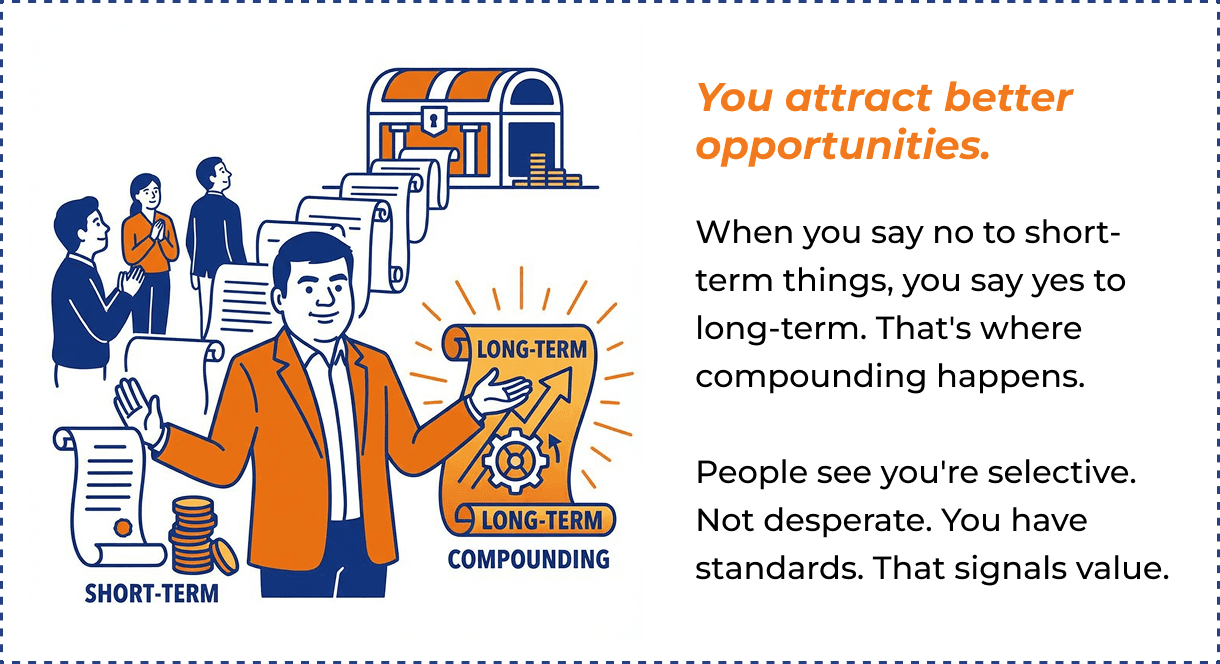
You get your time back.
Last year, I said no to countless meetings, full courses at premier institutions, and large corporate trainings. What did I say yes to? Building my team from 50 to 110 people. Learning management, HR, scaling. Building a tech team, launching our LMS, and adding the Learn-Mate feature. Reading dozens of books. Widening my horizon beyond finance.
You build respect and delegate.
I spent time training my team so they can handle clients. Things I used to do - client calls, consultations - my team does now. I'm a teacher to my students AND my team. We built an organizational structure. Everyone owns their domain.
The Corporate Training Trade-Off
Here's something interesting:
I say no to paid corporate trainings that need lots of my time. But I say yes to guest lectures at colleges, often for free. Corporates pay 5-10x more.
Why choose colleges? Because I enjoy being with students. Understanding their challenges. That interaction matters more than money.
The Investment Portfolio Analogy
In stocks, the sweet spot for diversification is 22-25 stocks. Beyond that, diversification benefits end.
Same with time. Hundreds of "good" opportunities exist. But you have limited bandwidth. Saying yes to everything is like holding 200 stocks. You can't manage anything properly.
Choose your 25. Say no to the rest.

How to Actually Say NO
For random opportunities:
"Thanks for thinking of me. This doesn't align with my current priorities."
Honest. Direct. Grateful. This aligns with the fourth kind of luck, opportunities through reputation.
For things you can't do:
"I appreciate this, but it's not my strength. Let me connect you with [person] who's better suited."
I redirect. Often to my own students. Don't apologize for your NO. You're choosing consciously. That deserves no apology.
Start Here

This week, list everything, taking your time. If something doesn't pass, remove it.
- That project that doesn't fit the long term? Say no.
- That obligation you dread? Decline politely.
Saying no to what doesn't serve you creates space for what does.
The Bottom Line
The mentor who'll teach you when to say yes to your career - and when to walk away.
Want to learn finance the way it's meant to be taught - with depth, application, and long-term thinking?
Learn from Aswini Bajaj →Until next week,
Aswini Bajaj